Thank you for your patience while we retrieve your images.
Uploaded 26-Jan-12
Taken 8-Oct-08
Visitors 57


43 of 175 photos
Thumbnails
Info
Categories & Keywords

Category:Objects
Subcategory:Close-ups
Subcategory Detail:
Keywords:12mp image, LF, Large Format Film, Large format, MF, MF, Mamiya RZ67, Mamiya RZ67 Pro II, Mamiya RZ67 Professional II, Medium Format film camera, Medium format film, Nikon D200, Nikon D300, Nikon D3X, Nikon D700, contempating MF, contemplating medium format, digital or film, film cameras, film vs. digital, fine art landscape, medium format, mf, professional landscape, switching to MF, switching to medium format, thinking about medium-format
Photo Info

Dimensions1360 x 1101
Original file size757 KB
Image typeJPEG
Color spaceAdobe RGB (1998)
Date taken8-Oct-08 10:53
Date modified24-Jan-09 09:20
Shooting Conditions

Camera makeNIKON CORPORATION
Camera modelNIKON D200
Focal length45 mm
Focal length (35mm)67 mm
Max lens aperturef/2.8
Exposure1/100 at f/14
FlashNot fired
Exposure bias0 EV
Exposure modeManual
Exposure prog.Manual
ISO speedISO 100
Metering modePattern
Digital zoom1x
Mamiya RZ67 Professional II

Mamiya RZ67 Professional II

If you're contemplating looking into medium format photography but aren't sure how well what you already know will translate to medium format, rest assured it's not too tough. 

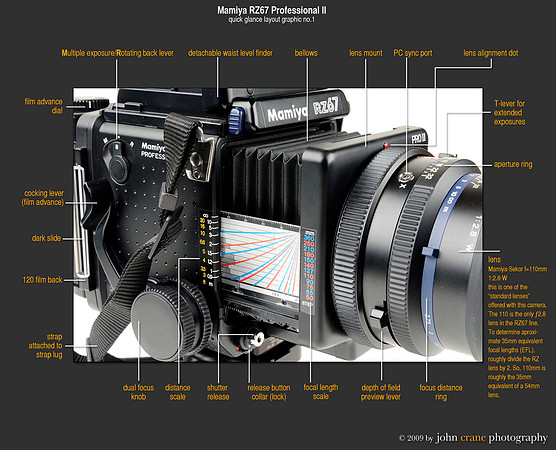
This graphic begins to provide a high-level view of some of the differences between the RZ67 from Mamiya (a popular medium 6x7 format camera) and your 35mm film or DSLR style cameras. This isn't new information, but recent in my mind because I've recently added Medium Format to my shooting schedule. This information would have been helpful to me if I'd found it early in my exploration, so hopefully it will help answer questions for anyone else contemplating medium format.

There are some important differences you'll need to know right off the bat: this camera has no metering built in as shown here. In order to determine exposure with this camera you need to use a second device (either a hand-held meter or your SLR/DSLR for the meter), or you need to pick up a different viewer than the waist level finder shown here. They ad bulk and weight to the camera, but may be worth it to get TTL (through the lens) metering.

Another thing noteworthy is with a waist level finder you're looking down through the open top of the camera (see image 5 or 4) directly onto the ground glass (focus screen). This has advantages and disadvantages. The disadvantage is that it's backwards (not upside down and backwards, like a large-format camera),  reversed left to right. This takes some getting used to. The advantage is, once your brain adjusts, you're looking directly down at the image you're shooting with both eyes. This is a composition plus because it allows you to see the photograph as you'll view it once the film is processed-not squint with one eye into a tiny hole.
Other advantages include a lighter, smaller camera; less drain on the battery and easier focus in low light: the image on the ground glass is the same size as the 6 x 7 frame you're shooting.

Another thing important to note is lens focal lengths. Many people's only reference is 35mm equivalents, so to determine what the 35mm equivalent of each RZ lens, you can *roughly* divide by 2. So the 110mm RZ lens shown here is roughly the equivalent of a 54mm lens in 35mm world. (NOTE: 645 system lenses are different)

A great advantage to this particular system is the ability to carry multiple backs in your camera bag. A roll of 120 film when shot in 6x7 format fits 10 pictures. Having multiple backs allows you to pre-load films so you're not loading when you'd rather be shooting. The big advantage, though is this: if you're half-way through a roll of 100 speed color transparency film and find a great shot for black and white, you can just swap out a pre-loaded back with your black and white film and keep shooting. When you're finished, put the back with color film back on and resume shooting color. This of course also applies to different speeds and emulsions: if you're shooting 800 speed film indoors and need to go shoot outdoors, you could just as easily swap out a back loaded with 100 speed, without wasting the rest of your roll just to switch films.

Feel free to DOWNLOAD this graphic for future reference. There will be more graphics to come as I shoot more angles and can explain things better. But be encouraged: medium format is fun, easy, inexpensive and best of all, able to produce truly huge, beautiful photographs.